
Behind the scenes at DDZM Web Design — the people, technology and decisions involved in creating a website.
Who actually builds your website?
Artificial intelligence has changed the way websites can be created.
Today, AI tools can suggest layouts, generate text, write code and help solve technical problems in seconds.
But does that mean a business website can be created simply by asking AI to build one?
And if a website designer uses AI, what exactly are you paying for?
At DDZM Web Design, we believe those are reasonable questions.
Our approach is human-led and AI-assisted. We use technology to support the work, but human judgment, real development decisions and accountability remain essential.
Here's how that works.
1. A real person remains responsible
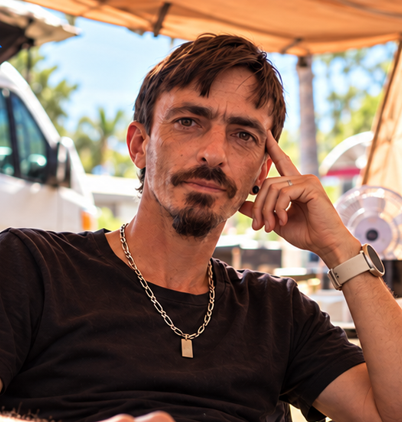
DDZM Web Design is led by its founder, Denis.
Behind the business is a genuine interest in technology, problem-solving, practical design and helping small businesses establish their online presence.
Denis brings experience from hospitality, business operations and information technology. That background influences how DDZM approaches customer needs: listen carefully, understand the problem and look for a practical solution.
DDZM also has an unusual collection of AI-assisted specialist roles.
You might have met Watson, our imaginary General Manager, or the colourful personalities featured in our Working with an Underpaid AI Team creative series.
They're fictional representations of AI-assisted functions, not human employees.
The humour is intentional. The distinction is important.
AI can assist with work. It doesn't replace the person responsible for the business, the customer relationship or the final decisions.
2. We start with the business, not the software
Before choosing layouts, colours or technical features, the important questions are about the customer's business.
Who are they trying to reach?
What do their customers need to know?
Should the website help visitors understand services, make enquiries, request quotes or take another action?
What information and materials are available?
What budget, requirements and ongoing responsibilities need to be considered?
These questions help shape a project that serves an actual purpose.
A website for a local tradesperson may need clear service information, service areas and an easy enquiry process.
A hospitality business may place greater emphasis on menus, opening hours, location and visitor information.
Both businesses need a useful website, but they don't necessarily need the same website.
Good website planning is about understanding people and their needs, not simply generating attractive pages.
3. Why we use WordPress
DDZM's current website-development approach is built around WordPress and Elementor.
WordPress provides an established content-management platform with extensive options for managing pages, articles, media and website functionality.
Elementor provides visual design and layout tools that can be combined with WordPress themes and other components.
We prioritise native WordPress and Elementor functionality wherever practical, helping keep websites maintainable and visually editable. Custom code is used when justified by a genuine technical requirement, with appropriate documentation and testing.
For DDZM, this combination offers several practical advantages:
Our own DDZM website also uses a child theme, allowing specific customisations to be kept separate from its parent theme.
However, WordPress isn't automatically the right solution for every possible project.
Different platforms have different strengths, limitations, costs and portability considerations.
The important thing is to choose technology for a reason — and to explain those reasons clearly.
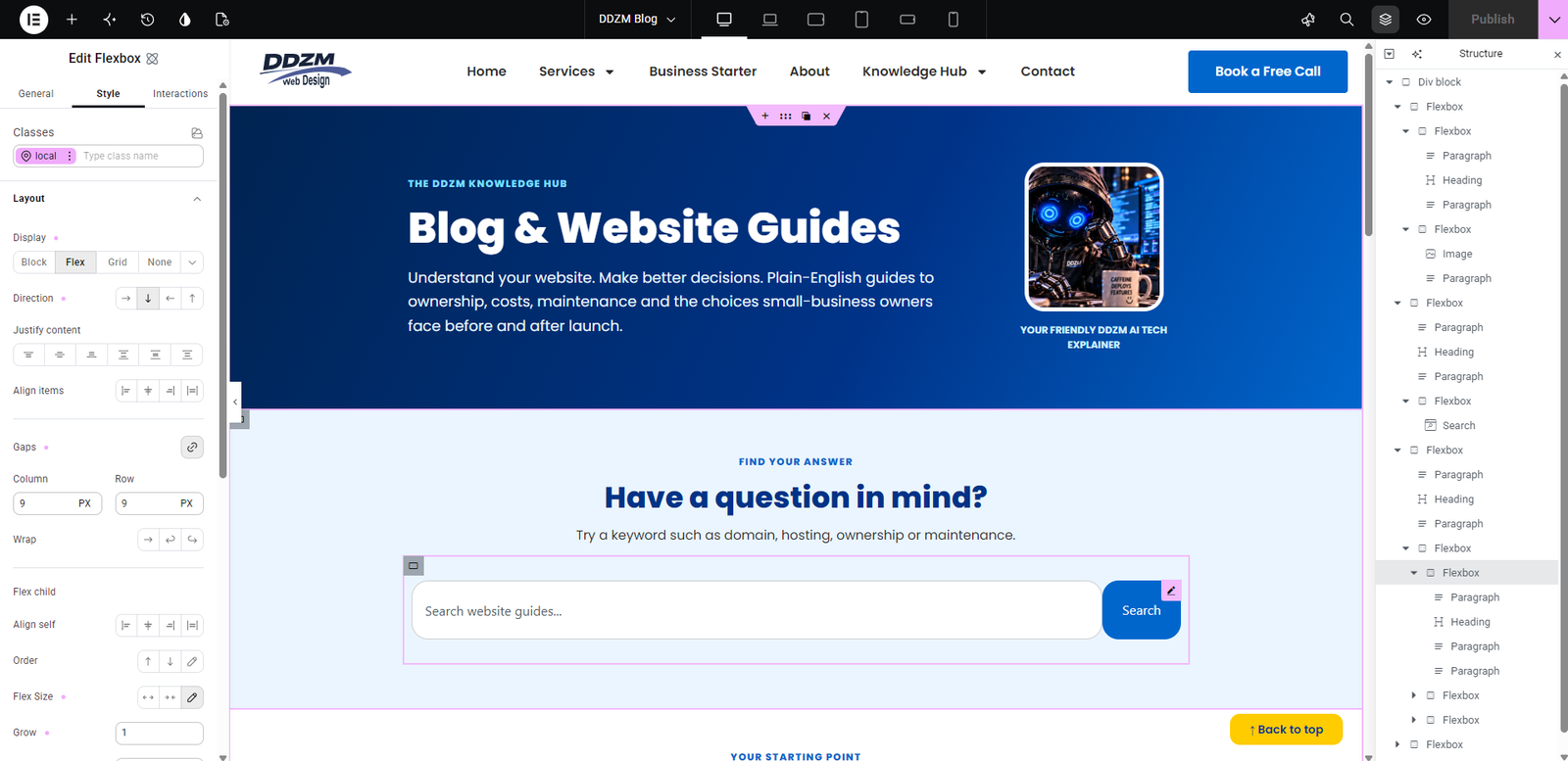
Behind the scenes: DDZM uses Elementor's visual editor and page structure controls to build and maintain website layouts.
4. Why we don't just install everything
A website can use additional tools for purposes such as caching, security, forms, analytics and search optimisation.
DDZM's own website uses tools including LiteSpeed Cache, Wordfence, Rank Math and Google Site Kit, alongside its WordPress and Elementor foundation.
But installing a plugin doesn't automatically make a website fast, secure or effective.
Each component adds something that must be understood and maintained.
For example:
We prefer to consider what is actually necessary rather than treating the number of installed features as a measure of quality.
Technology should support the website's purpose, not make it unnecessarily complicated.
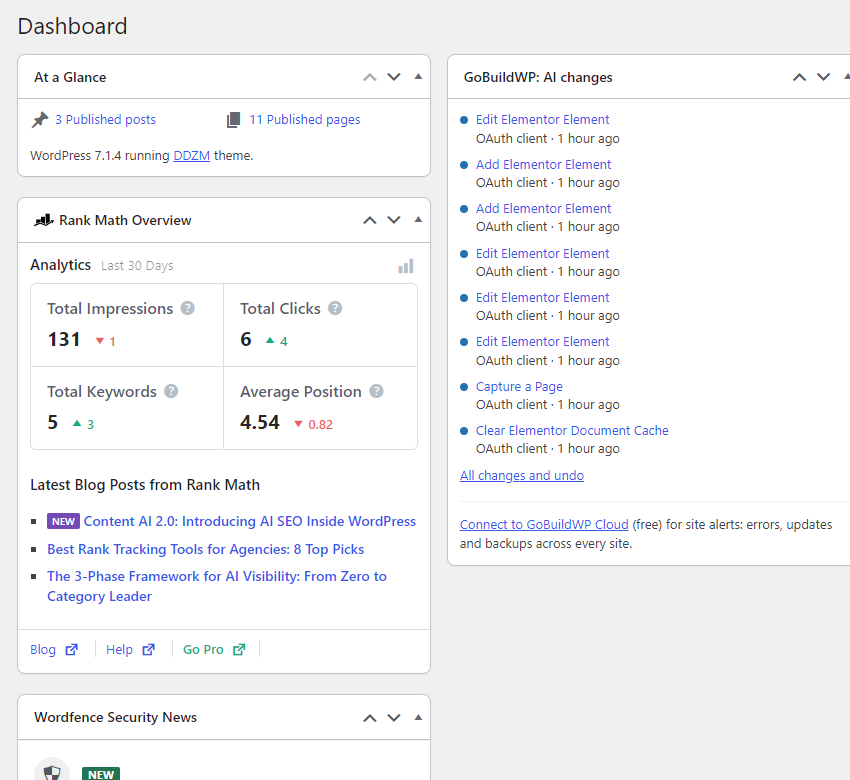
An example from DDZM's WordPress dashboard: content, SEO indicators and recorded site changes help inform technical decisions.
5. Where artificial intelligence helps us
AI-assisted tools can be useful throughout a website project.
At DDZM, they can help with activities such as:
Research and planning: Exploring approaches, organising requirements and comparing possible solutions.
Content development: Preparing drafts, identifying confusing explanations and improving clarity.
Design exploration: Considering layout ideas, content structures and different ways to present information.
Technical assistance: Suggesting code, explaining technical behaviour and helping investigate problems.
Review and documentation: Organising findings, preparing checklists and recording decisions.
These capabilities can make it easier to explore ideas and identify possibilities.
But there is a critical limitation.
AI-generated output is not automatically correct, appropriate, secure or suitable for a customer's website.
An AI tool may produce code that looks convincing but doesn't behave as intended. It may suggest a feature that isn't necessary, overlook a compatibility issue or provide incorrect information.
That's why using AI responsibly involves reviewing its output, checking important claims and testing technical changes before relying on them.
The benefit isn't simply that AI can generate something quickly.
It's that AI can assist a person who understands the objective and remains responsible for the outcome.
6. What about 'vibe coding'?
You may have heard the phrase vibe coding. It commonly describes using AI to create software through prompts while accepting the generated code with little direct inspection or understanding. That is different from AI-assisted development where technical decisions, code review, testing and maintainability remain part of the process.
AI-assisted coding can be useful. The presence of AI-generated code doesn't, by itself, determine whether a project is good or bad.
What matters is the process surrounding it.
Does someone understand what the code is intended to do?
Is the proposed solution appropriate for the website?
Has it been reviewed for potential problems?
Has it been tested in the environment where it will operate?
Can it be maintained or changed later?
At DDZM, our aim is not to treat generated code as finished work simply because an AI tool produced it.
When custom code or configuration is needed, the important work includes understanding its purpose, integrating it appropriately and checking the result.
Generating something is not the same as delivering something reliable.
7. What happens after a page has been designed?
A website that looks attractive in an editor still needs to be checked in practice.
Depending on the project and agreed scope, website testing may involve reviewing:
These checks can reveal issues that aren't obvious when looking at a design in isolation.
A layout may look fine on a large screen but become cramped on mobile. A button may look correct but lead nowhere. A form may accept information without delivering the enquiry as expected.
Finding and correcting these issues is part of real website development.
No website can be guaranteed to be perfect or free from future problems, but testing and review are important ways to reduce avoidable mistakes.
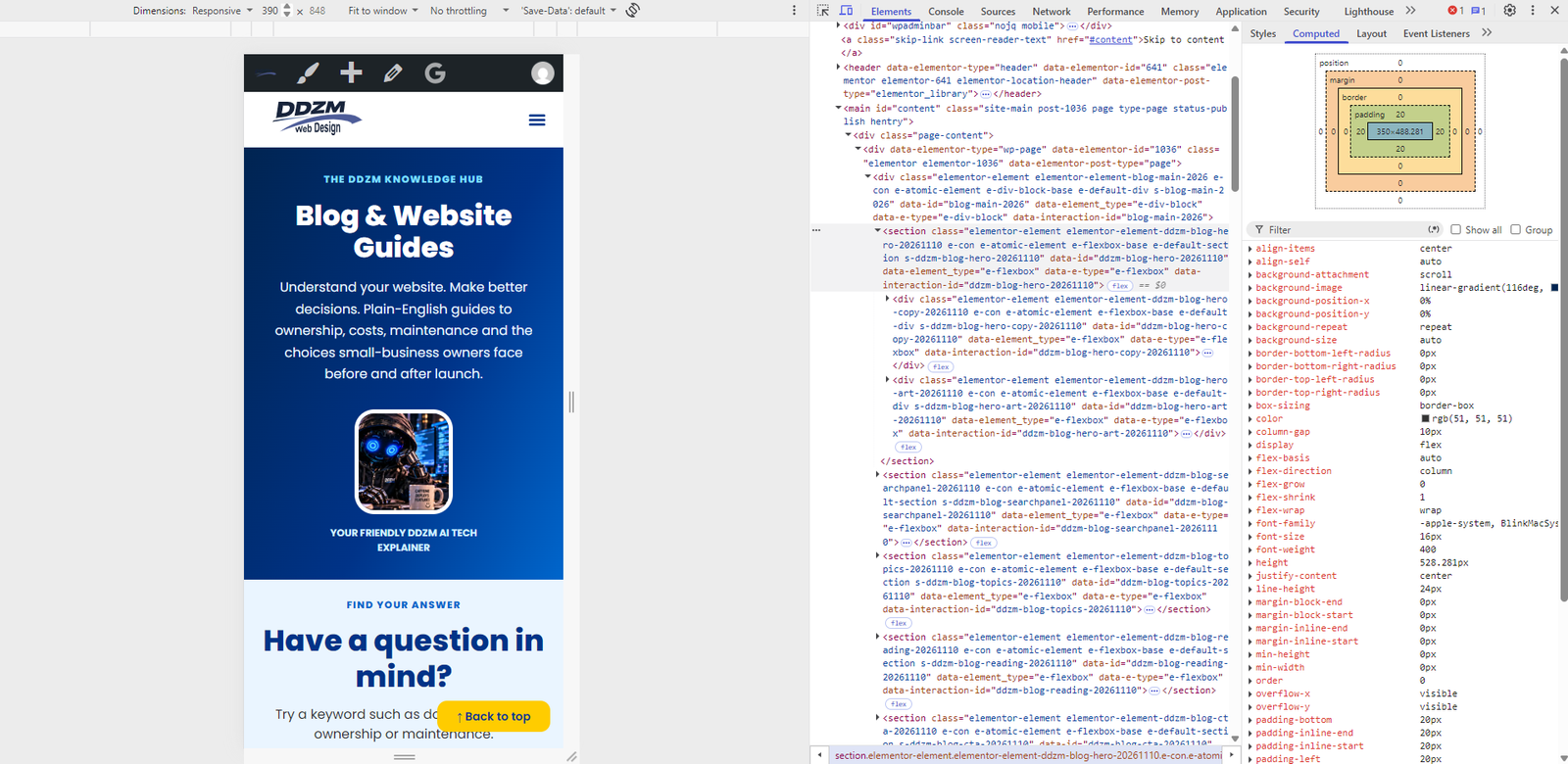
Responsive review in practice: inspecting DDZM's mobile layout alongside browser developer tools.
8. Why transparency matters
When you engage a website provider, it's reasonable to ask how your website will be built, what tools are involved and what responsibilities continue after launch.
It's also reasonable to ask about ownership, licensing, hosting, future changes and maintenance.
Using AI doesn't remove the need for those conversations.
Nor does using WordPress automatically determine what a customer owns or which services are included.
Those details depend on the project, the applicable agreements, licences and other relevant requirements.
We explore these questions in our companion article:
Do You Really Own Your Website? What Australian Small-Business Owners Should Know
9. The person and the tools work together
DDZM doesn't pretend AI isn't involved in its work.
We believe being transparent about modern tools is more useful than hiding them or using them as a marketing gimmick.
Our philosophy is straightforward:
Human responsibility. AI assistance. Practical technology. Thoughtful development. Real testing.
The tools may evolve. The technology may change.
But our objective remains to create websites that make sense for the businesses using them, with clear communication about what is being delivered.
Want to know more?
If you're considering a website and would like to understand your options, we'd be happy to have a conversation.
You don't need to arrive with technical knowledge or a complete plan.
Tell us about your business and what you're hoping to achieve.
Specific services, project inclusions, responsibilities and deliverables are determined by the agreed scope and applicable customer terms.